I built a machine that watches new products go live

This is the second post in a series about FlatNine Intelligence. The first was about the news feed, a system that reads the world at macro scale. This one is about its sibling: Launches, a feed that catches new products at the exact moment they come to life.
I build small software for a living, and I back a little of it too. Which means I am endlessly, slightly compulsively curious about what other people are shipping. Especially now: the vibe-coding wave (Lovable, v0, Bolt, Replit, and the rest) means a lot more people are shipping a lot faster than they used to.
The problem is timing. By the time something reaches Product Hunt or my timeline, it has already been announced, polished, and is weeks old. I did not want the announcement. I wanted the leading edge: products at the exact moment they come into the world, before anyone has said a word about them.
It turns out you can watch that happen. So I built something that does.
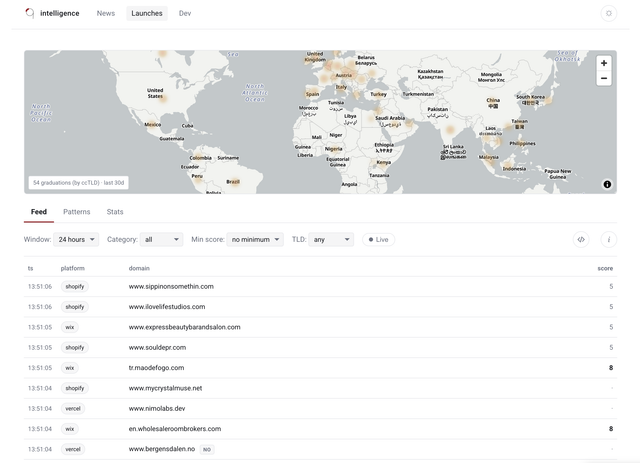
The graduation moment
Out of everything that happens on the web every day, there is one specific event I care about, and the whole feed is built to catch it:
The instant a project hosted on a platform (Vercel, Render, Shopify, Webflow, Squarespace, Lovable, and 40+ others) attaches its own custom domain for the first time.
That is the moment a side project decides it is real. Someone bought a domain, pointed it at the thing they made, and shipped. I call it the graduation moment, and catching it is the entire point of the feed.
Sorting for the real products
Most graduations are marketing sites and hobby pages. To surface the ones that look like actual products, each row gets a crude score (out of 23) that just sums up tells:
- the subdomain looks like an app (
app,api,dashboard,admin,portal) - it landed on a serious backend (Render, Railway, Fly) rather than a static host
- it is a
.aidomain (intentional, expensive, and almost always a real product)
Sort by that score and the obvious cream floats to the top. It is deliberately blunt. It is a way to point a human at the interesting rows, not a verdict on anyone's business.
The part I find most fun: discovery
Here is the bit I am quietly proud of. Every record that looks like a graduation but does not match any platform I know about goes into a discovery pile. Group those by where they point and rank them by how many distinct customers each destination has, and you find the next platform to add to the catalog before you would have heard of it anywhere else. The feed teaches me about new tools by watching their customers show up.
The same view has a dark mirror. Pirate-streaming farms, gambling and affiliate redirect networks, and SEO link farms all use the exact same multi-tenant routing playbook as legitimate platforms, just pointed at worse ends. Watching the discovery pile is watching both the next Vercel and the next link farm assemble themselves in public.
What it feels like to use
There is a Live toggle, and with it on, new rows flash in every few seconds: a constant scroll of brand-new domains with their platform tags and country flags. Filter to .ai and you are watching the AI-product wave arrive in real time, name by name. It is genuinely mesmerizing in a way I did not expect, a window onto the leading edge of what people are building this exact afternoon.
What I actually use it for
Mesmerizing is nice, but the feed earns its keep in three concrete ways:
- Lead generation. Every new store that comes online is a fresh, unclaimed lead. I can hand an agency a daily list of brand-new Shopify and Webflow stores in their niche, just days after the store exists and well before it surfaces anywhere else. A pipeline of businesses that just started and need help is exactly what agencies pay for.
- Alt-data. Because I see graduations the moment they happen, I can measure how fast any given platform is adding real customers, week over week. "Shopify added this many net-new stores this month, here is the curve" is the kind of adoption signal a hedge fund will pay for, long before it shows up in a quarterly report.
- Finding buyers for my own products. When a launch matches the profile of someone who would want one of my products, that is a warm intro waiting to happen. The feed turns into a list of people I should be talking to today.
What the data is telling us
Once you classify enough launches, patterns fall out. A few that changed how I think:
- AI-native creation is now the dominant mode. Of the launches we have classified recently, roughly one in three is AI-native and about half are at least AI-touched. The purely agentic slice is the smallest pool (around 104K) but the fastest-moving.
- Build-volume sorts into clear value tiers. Builders (no-code sites) is the biggest bucket at 1.64M records and the lowest value per record. E-commerce (742K, Shopify-dominated) and dev tools (534K) are smaller but far more concentrated and monetizable. The biggest bucket is a trap, not an opportunity.
- The news feed, by contrast, is pure geopolitics. Its top entities are Iran, the US, Trump, Israel, China, Ukraine. That is macro weather, not a map of what to build, so we treat it as backdrop only. Same lesson either way: know what a signal is, and what it is not.
- In every vertical, people are building the same AI assistant. Legal (207), recruiting (38), voice receptionist (10), real estate (411). When a vertical floods with near-identical assistants, the move is not to ship the 411th one. It is to sell the data underneath them, but only where we already own that data.
- That one rule sorts our whole portfolio. We own data for e-commerce (Cart), US real estate (FastLand, FastLien, LendLinker), and leads (Leadbrew). We do not own legal, recruiting, or voice data. So the call is clean: sell data into the first set, do not build into the second. Geography gates it further, our real-estate data is US-only while the real-estate AI wave is global.
Why I keep building these
This is the same instinct as the news feed, pointed somewhere else. Find a public firehose that almost nobody watches at full resolution, structure it, and surface the one signal worth seeing. There, the firehose was the world's news and the signal was where things are going. Here, the firehose is the birth certificate of the web, and the signal is: something new just arrived.
In the next post I will go under the hood of the engine these feeds share, the entity graph and the gravity score that lets the system notice what is becoming important.
This is the kind of thing I build at FlatNine. You can watch the live Launches feed at intelligence.flatnine.co/launches, and I post the builds @mikerubini.