I built a machine that watches what the best builders star

This is the third post in a series about FlatNine Intelligence. The first was about the news feed (reading the world at macro scale), the second about Launches (catching new products the moment they go live). This one is about the third sibling: Dev, a feed of what is actually climbing on GitHub right now.
I build software for a living, so a real part of my job is keeping up with the tools. Which library, which model, which framework, which weird little utility that quietly solves a problem I have been working around for a year. The cost of being late to a good tool is real, and the cost of adopting a bad one is worse.
The problem is that the obvious signals are all late. By the time a tool is on the front page of Hacker News or has a launch thread doing numbers, the people whose taste I trust starred it weeks ago. I did not want the hype. I wanted the thing that happens just before the hype: the quiet star from someone who builds for a living.
It turns out you can watch that too. So I built a feed for it.
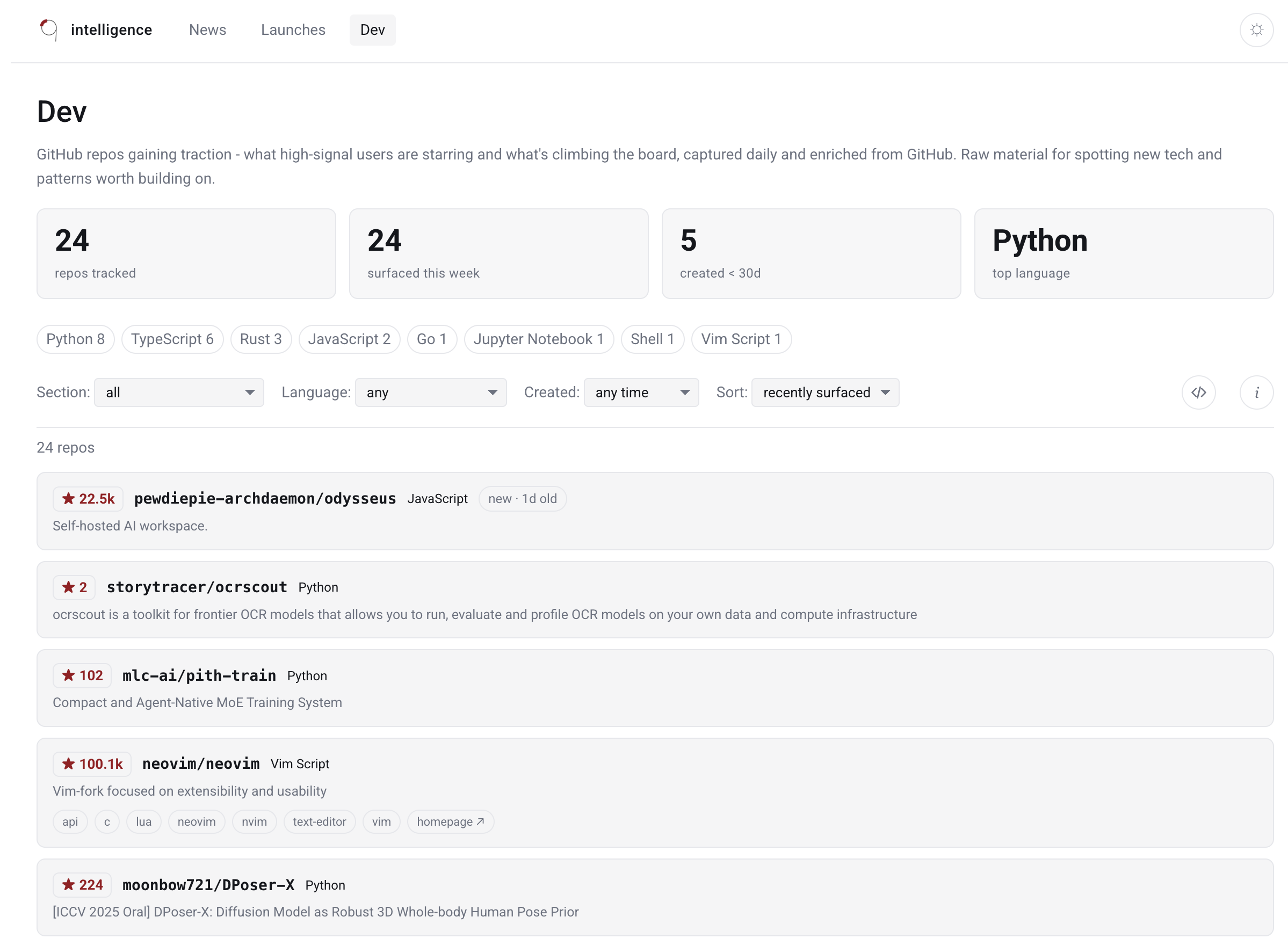
The signal I actually care about
The feed tracks two things, and the second is the one that matters most to me.
The first is the obvious one: the week's most-starred repositories. Useful, but it is a popularity contest, and popularity is a lagging indicator.
The second is the latest stars from high-signal GitHub users: the people with deep reputation in the ecosystem, the ones who have built things you have heard of. When a handful of them star the same obscure repo in the same few days, that is the earliest honest signal I know of that something is worth a look. It is taste, captured at the moment it is expressed, before it has had time to become consensus.
Where the data comes from
Every few hours the system pulls an upstream GitHub-activity board and reads two sections off it: "Most Stars" for the week, and "Top users' latest star." It parses out every repository link in board order, so it keeps not just which repos are present but where they rank.
That scrape is idempotent. When a repo shows up again, the system merges its sections, keeps the best rank it has ever held, and bumps a seen-count and a last-seen timestamp. So over time each repo carries a little history: how high it climbed, how often it has surfaced, when it first appeared on my radar.
Filling in the truth
The board tells me a repo is interesting. GitHub itself tells me what it actually is. A second job takes each repo and asks GitHub's own API for the authoritative metadata: stars, forks, primary language, topics, license, the owner type, and crucially the creation date and the last-push date. That runs on a steady cadence and refreshes the popular repos every few days so the star counts do not go stale.
The result is that every row is two things stitched together: a signal that someone whose taste I trust just looked at this, and the hard facts about what "this" is.
The "brand new" filter
Here is the filter I reach for most. Because every repo carries its real creation date, I can ask a pointed question: show me only the repos created in the last 30 days that are already climbing.
That cuts straight to the leading edge. A repo that is a few weeks old and is already pulling stars from serious builders is the closest thing I have found to a time machine for developer tooling. It is where the next default library or the next standard pattern is taking shape, usually months before it has a name everyone recognizes.
What I actually use it for
The feed is, bluntly, raw material for what to build and what to build with.
- Spotting new tech early. When a cluster of high-signal engineers starts starring the same young project, I go read it. Half the time it changes how I would approach a problem I am already working on.
- Reading where attention is moving. The language and topic breakdown across the feed is a live map of what the ecosystem is investing its energy in this month. That tells me which bets are getting crowded and which corners are still quiet.
- Finding patterns worth productizing. A tool that keeps surfacing is often pointing at a problem a lot of people suddenly have. Sometimes the opportunity is not the tool itself, it is the product that the tool makes newly possible.
Why I keep building these
This is the same move as the other two feeds, pointed at a third firehose. Find a public stream that almost nobody watches at full resolution, structure it, and surface the one signal worth seeing. For the news feed, the firehose was the world's events and the signal was where things are going. For Launches, it was the birth certificate of the web and the signal was that something new just arrived. Here, the firehose is what builders are paying attention to, and the signal is what is about to matter.
Three feeds, one instinct. In the next post I want to go under the hood of the engine they lean on, the entity graph and the gravity score that lets the system notice what is becoming important before it is obvious.
This is the kind of thing I build at FlatNine. You can browse the live Dev feed at intelligence.flatnine.co/dev, and I post the builds @mikerubini.